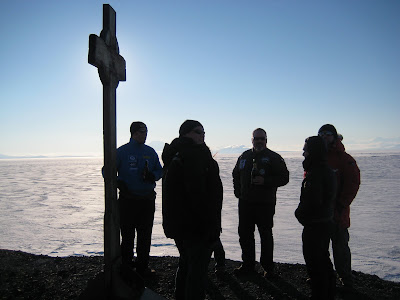
It's been a busy, cold, snowy week at the other end of the globe.
I arrived on station just over a week ago and it seems a blur already. My first two days were a weekend and because of the New Year, this was the last two-day weekend for the season. Saturday was the annual IceStock music festival - what great fun! I got a bit spoiled on the weather as it turns out: Saturday was sunny and well above freezing. When I stepped out of the dorm on Sunday morning I immediately had to turn around and go back to add a layer of clothing - since last Saturday, weather has been a bit more typically cold for around here. The departing chaplain retained all worship responsibilities last Sunday so I had the day to meet people.
Monday is the "military day" for me. I wear my uniform for a weekly meeting and end up visiting with the other military folk down here. Last week, I rode out to the flight line and visited the different shops out at "Pegasus." There are three different runways that can be used down here, an ice runway that is open early in the season until the ice is too warm to safely accomodate the airplanes - within a month or so of it shutting down, an ice breaker comes in to clear a channel for the two other ships that port here (more on that later). Another runway is an old airstrip thats not open this year as a cost-saving measure. Williams Field, usually called "Willy Field" is named for a sailor Richard Williams whose tractor dropped into the Ross Sea in 1956. (I'm told divers have been down to the wreck and he's still gripping the steering wheel pretty tight.) I think that the Navy used Willy Field as their primary airstrip and so when a plane crashed nearby in the 50s or 60s, they towed it several miles away onto the floating glacier because it's considered bad luck to have to look at a crashed plane every time you come in for a landing. Well, the plane they towed away was called "Pegasus" and the place they happened to leave it turned out to be an ideal location, with just a little shoveling, to land a C-17. And so the third, and now only open, landing strip down here is called Pegasus in honor of the wreckage you can easily see from the runway.
Much of the rest of the week was spent waiting. My Roman Catholic counterpart flew to the South Pole in what was supposed to be an overnight trip on Monday. He came back late Thursday. The chaplain I'm replacing was supposed to fly out on Tuesday. He left Friday. The weather here has been too windy and too snowy to fly safely, so the flight crews have had some waiting and time off. I see them in the cafeteria in flight suits looking at the clock waiting for the next update - will it be a three-hour delay? a 24-hour weather cancellation?
But even though they have a lot of waiting, most of the other activities here don't slow down at all. I met Dick this week, an IT guy down here for his first season, who shared with me his theory that I'm beginning to think might have some truth in it: when the planes leave New Zealand, they fly through a space warp and we actually travel to a different planet. If I were going to imagine a colony on the moon or Mars, I'd start with McMurdo as a model. We generate our own power, desalinate our own water, treat our own waste, drive and maintain trucks and tractors almost as old as my parents (sorry Mom and Dad) and are completely dependant on the incoming flights for food, supplies, medicine, the works. This place is constantly humming with the work that needs to happen to keep McMurdo open. I got to tour the waste treatment plant with Kurt from Cleveland (layed off last summer and found this work), the water desalination plant with Paul (a retired high school teacher), and the power plant with Mike who answered a Craiglist ad for work. Dave showed me around the Vehicle Maintaince Facility, a place he's been working at for over 20 years. Nick and Sparky explained the exhasutive recycling and trash programs at work here (we sort our trash into EIGHT different bins, and bus our dishes in the galley into four different stations, Uncle Kent!). I heard from someone there are more than 100 support people for each scientist down here.
And science runs this place. I've met folk who drill deep into the ice to get air samples from thousands of years ago. SCUBA divers who swim beneath the ice and return with fish, starfish, sea spiders, anenome, and more. A team from the University of Kansas out here with an unmanned aerial vehicle to scan the ice for cracks and crevasses. Guys who send balloons into space from here to orbit the earth. Folk whose telescopes look deep into the heavens calculating the exact moment of the Big Bang. Hardy researchers whose three-year project is to capture the dust here with possible applications to space settlements on Mars. At the South Pole, there's a team looking at neutrons or neutrinos or something of the sort that have passed all the way through the Earth. The active volcano here is so unique, only one other on Earth erupts in the same way - and ironically its safer to come here to study it than to risk getting involved in Africa's civil wars.
My time is spent getting to know these people. Hearing their stories. Listening to their passions and heartbreaks. Many have family back home they miss dearly but are here for work they can't find back in the states. Some have been trying to get here for years and years - one woman said she'd applied nine times for a job here. Some are kinda lost, not sure how they ended up here. Someone's organizing a stage version of the Princess Bride. Some drink their paychecks away. Some come to get away from something in the "real world." Some come to find something they've lost or heard about. It's tender work, holding these stories.
Even though it's cold and snowy, Antarctica is officially considered a desert because of how little precipitation it gets (a lot of the snow here doesn't fall from the sky as much as it get's blown over from another part of the continent). People come to the desert for many reasons.
Well, the constant daylight means it's easy to lose track of time. It's late here, though the windows don't tell me that, and I get to preach and lead worship tomorrow for the first time in several months. After that, I plan to visit Scott's Hut and hopefully tomorrow night take a trip out to see the four penguins that have settled near Pegasus and begun to molt. A full day.


